Solenoid Valve vs Pneumatic Valve: Actuation Differences and Selection Guide
Solenoid valves are driven directly by an electromagnetic coil — fast, compact, easy to integrate. Pneumatic valves are driven by compressed air — high force, inherently explosion-proof, capable of holding position on power loss. Choosing between them is a trade-off between electric and air actuation.
What Is a Solenoid Valve
A solenoid valve is a control valve actuated by an electromagnetic coil. Energize the coil and the magnetic field pulls the plunger, which lifts or presses the seal (diaphragm, piston, or spool) to open or close the flow path; de-energize and the return spring pushes the seal back. Its core job is to turn an electrical signal into a fast on/off action.
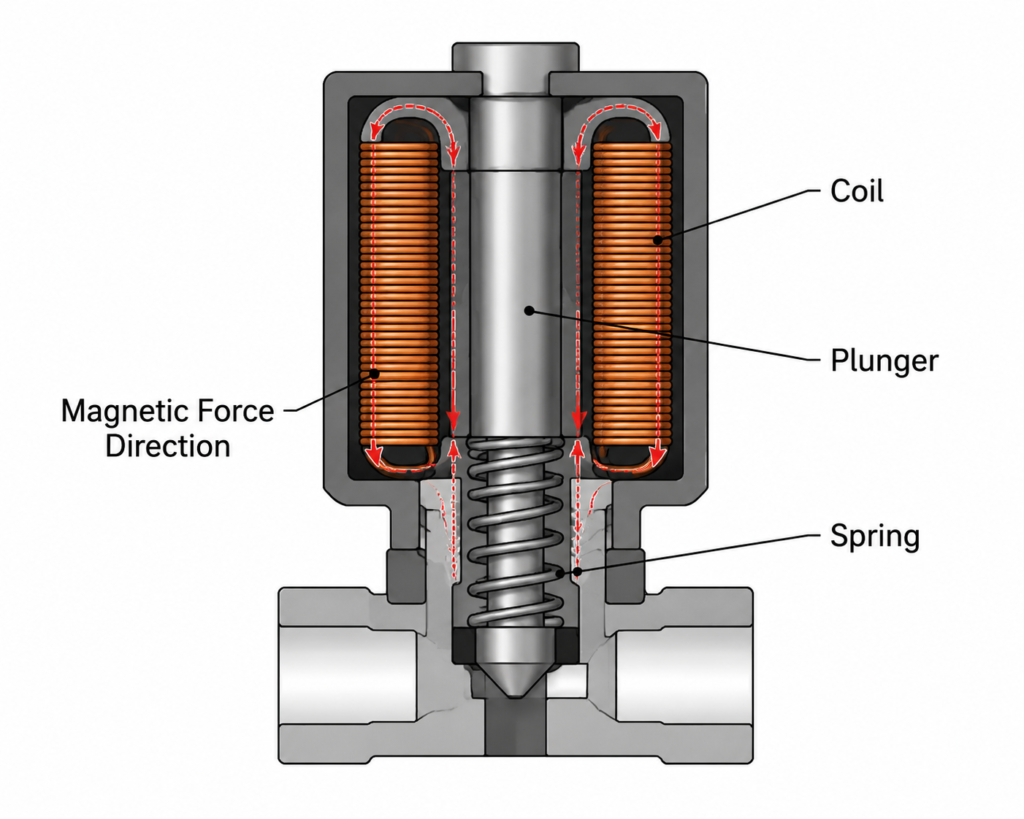
The common types you’ll choose between:
- By port count (ways): 2-way (simple on/off), 3-way (diverting or mixing flow paths), 4-way (controls double-acting cylinders).
- By actuation: direct-acting (coil drives the spool directly, fastest response, suited to small bore and low pressure), pilot-operated (opens a small pilot port first, uses media pressure to drive the main spool, suited to large bore and high pressure).
What Is a Pneumatic Valve
A pneumatic valve is a control valve actuated by compressed air pressure. The air pushes a piston or diaphragm in a cylinder, which moves the spool. The fundamental difference from a solenoid valve is the energy source: one uses electricity, the other uses air. Pneumatic valves are commonly used to control air circuits or large-bore flow paths, and in applications that need high driving force.
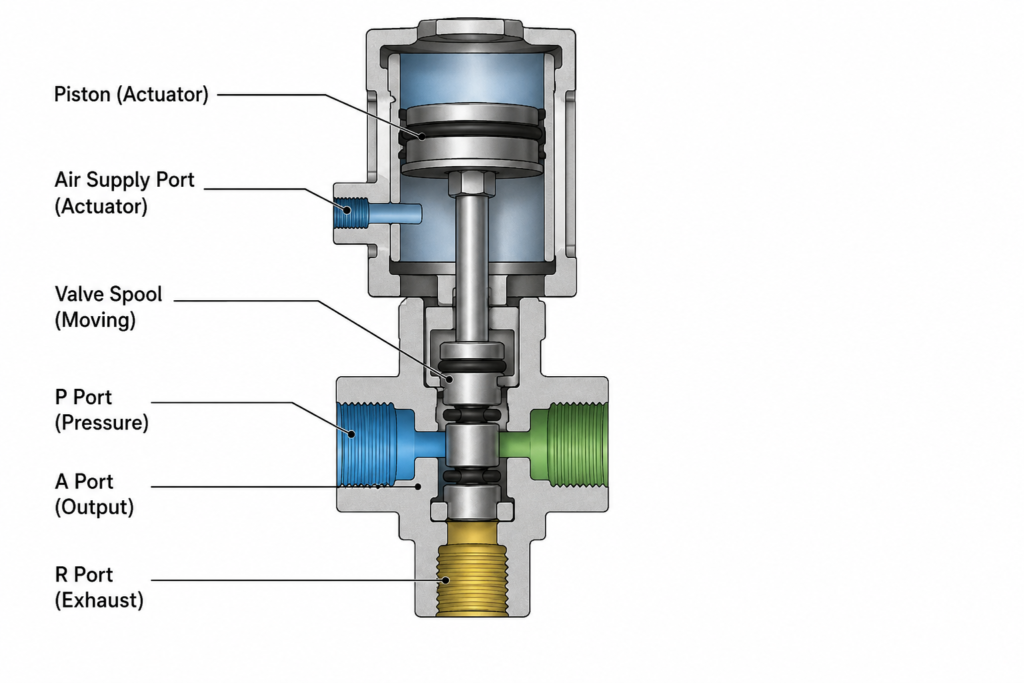
Common types:
- Directional control valves: classified by positions/ports — 2-position 2-port, 2-position 3-port, 2-position 5-port, etc. — to open/close and redirect air circuits; the most common type in pneumatic systems.
- By actuation: air-piloted (driven by another air signal), electrically piloted (a small solenoid pilot controls the air circuit — the “solenoid-piloted pneumatic valve,” covered in the integration section below), or manual.
Key Differences at a Glance
| Dimension | Solenoid valve | Pneumatic valve |
|---|---|---|
| Actuation energy | Electricity (AC/DC) | Compressed air |
| Response speed | Very fast, millisecond range | Fairly fast, limited by line length and air volume |
| Force / suitable bore | Small-to-medium bore, low-to-medium pressure | High force, scalable (larger actuator / higher air pressure) |
| Air supply infrastructure | Not needed, power only | Requires compressor + filter + regulator + piping |
| Hazardous-area safety | Uses electricity, spark risk, needs explosion-proof certification | Fully air-driven, inherently explosion-proof |
| Electronic control integration | Direct PLC / microcontroller interface | Often needs a pilot interface |
| Behavior on power loss | Usually returns to spring position (open or closed) | Can be designed to hold position / fail-safe |
Key Differences in Detail
Response Speed and Cycle Frequency
A solenoid valve drives the plunger directly via the coil, responding in milliseconds — well suited to high-frequency cycling. Fuel injectors and fast-dosing applications can actuate thousands of times per minute without issue. Pneumatic valves aren’t slow, but they have to fill and exhaust the cylinder first, and response is limited by line length and chamber volume: the longer the air path and the larger the cylinder, the longer the fill/exhaust time, so they can’t match a solenoid valve in high-frequency duty.
Force, Pressure, and Scalability
A solenoid valve’s driving force is bounded by coil size and heating — to scale up bore or pressure you need a bigger coil, and continuous energization generates heat, so solenoid valves are mainly used for small-to-medium bore and low-to-medium pressure. A pneumatic valve’s strength is scalable force: increase the cylinder diameter or raise the air pressure and the driving capability rises proportionally, making it suited to large bore, high pressure, and heavy loads without being constrained by coil heating.
Power Infrastructure and Installation
A solenoid valve is self-contained — connect power and piping and it runs, with a small footprint and simple wiring. A pneumatic valve depends on a full air-supply infrastructure: compressor, filter, regulator, receiver, fittings — a heavier, larger system with higher upfront and maintenance costs. If your site has no existing air supply, installing a compressor system just for pneumatic valves rarely pays off.
Hazardous-Area Safety
A solenoid valve uses electricity at the valve location, creating a spark risk; to enter flammable or explosive areas you must select an explosion-proof certified model (which is more expensive and limits your options). A pneumatic valve’s field end is entirely air-driven — no spark, inherently explosion-proof — making it the safer choice in chemical, oil-and-gas, and dusty environments, and saving the cost of explosion-proof certification.
Control Integration and Fail-Safe Behavior
A solenoid valve interfaces directly with a PLC, microcontroller, or relay — the simplest path to electronic control, ideal when you need remote or precise electrical control. A pneumatic valve usually needs a pilot interface (most often a solenoid pilot valve), adding one integration layer. On power loss, a solenoid valve typically returns to its spring position (open or closed); a pneumatic valve can be designed to hold position on air or power loss (fail-safe or stay-put), which is critical in certain process-safety scenarios.
Pros and Cons
Solenoid Valve
Pros: Extremely fast response, compact footprint, low power draw at small sizes, direct electronic-control integration.
Cons: Force-limited at large bore / high pressure, heat generation under continuous energization (duty cycle must be right), higher cost at large bore, explosion-proof certification required for hazardous areas.
Pneumatic Valve
Pros: High and scalable force, inherently explosion-proof (suited to hazardous environments), can hold position on power loss, durable and reliable.
Cons: Depends on air-supply infrastructure (heavy system, large footprint), high upfront and maintenance cost, slightly slower than a direct-acting solenoid valve.
How to Choose: by Scenario
- Solenoid valve: small-to-medium bore, low-to-medium pressure, high-frequency cycling, power available on site, need for electronic or remote control.
- Pneumatic valve: large bore, high pressure, heavy loads, hazardous / explosion-proof areas, need to hold position on power loss, existing air supply on site.
- Integrated solution: when you need both electronic-control precision and the pneumatic valve’s high force — see the next section; this is the most common combination in practice.
Integrating Both: Solenoid-Piloted Pneumatic Systems
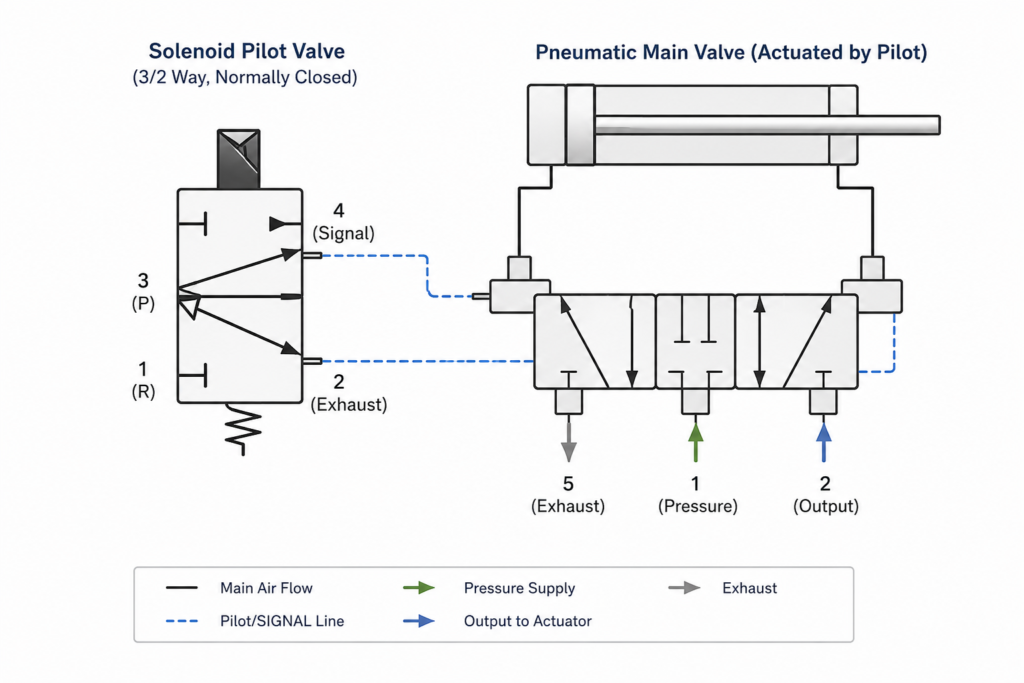
Often “solenoid valve vs pneumatic valve” isn’t an either/or — it’s a combination. The most common is the solenoid-piloted pneumatic valve: a small solenoid valve acts as the pilot, controlling the air signal that drives the larger pneumatic valve’s high-force output.
In principle, the small solenoid valve receives the electrical signal and quickly switches the air circuit; the main pneumatic valve uses air pressure to drive the heavy load. This pairs the solenoid valve’s electronic controllability with the pneumatic valve’s high force — electronic precision plus air-driven power, solved in one unit. Many “pneumatic valves” referred to on site are actually this solenoid-piloted construction.
Quick Selection Checklist
Answer these questions against your system to settle the direction:
- How large is the bore, how high the pressure? Small-to-medium, low pressure → solenoid valve; large bore, high pressure → pneumatic valve.
- Is there an existing air supply on site? Yes → pneumatic valve viable; no, and a standalone supply doesn’t pay off → solenoid valve.
- Hazardous / explosion-proof area? Yes → pneumatic valve (inherently explosion-proof), or an explosion-proof-certified solenoid valve.
- Need high-frequency cycling? Yes → solenoid valve (millisecond response).
- Need to hold position on power loss? Yes → pneumatic valve (can be designed fail-safe).
- Need both electronic control and high force? Yes → solenoid-piloted pneumatic integrated solution.
FAQ
Are solenoid valves more expensive than pneumatic valves?
Not necessarily. Small solenoid valves are typically inexpensive, but cost rises sharply at large bore, high pressure, and with explosion-proof certification. A pneumatic valve’s unit price depends on spec, and it also carries the cost of air-supply infrastructure. Overall, a solenoid valve is more economical for small bore; for large bore it comes down to whether you already have an air supply.
How much faster do solenoid valves respond compared to pneumatic valves?
Solenoid valves respond in milliseconds, driving the plunger directly via the coil. Pneumatic valves have to fill and exhaust the cylinder, limited by line length and chamber volume, so they’re generally slightly slower than a direct-acting solenoid valve. In high-frequency cycling the solenoid valve’s advantage is clear.
Can solenoid valves be used with any type of fluid?
A solenoid valve can control liquids or gases, but you must match the body and seal materials to the medium (corrosiveness, temperature, viscosity). Pneumatic valves are mostly used in air circuits, though some handle other media — selection is by medium in the same way. Mixing media blindly will damage seals or jam the spool.
How long is the life of a pneumatic valve?
Pneumatic valves are generally durable; life depends mainly on cycle frequency, air cleanliness (moisture/oil/particulate wears seals), and maintenance. With regular draining, filtering, and seal replacement, service life can reach millions of cycles. Dirty air is the number-one cause of premature pneumatic-valve failure.
Can a pneumatic valve run without a solenoid?
Yes. A pneumatic valve can be purely air-piloted (driven by another air signal) or manually actuated — a solenoid pilot isn’t mandatory. But if your system already has electronic control (a PLC, etc.), using a solenoid pilot valve to convert the electrical signal into an air signal is the most convenient integration path.
Conclusion
The difference between solenoid and pneumatic valves comes down to actuation: solenoid valves use electricity — fast, precise, compact; pneumatic valves use air — high force, stable, inherently explosion-proof. Choose a solenoid valve for small-to-medium bore, high frequency, and where power is available; choose a pneumatic valve for large bore, high pressure, hazardous areas, hold-position needs, or where an air supply already exists; when you need both, use a solenoid-piloted pneumatic system. Keep this main line clear and selection stays on track.
If you’re selecting a solenoid valve and need help matching port count, bore, voltage, and medium, [view our solenoid valve product range] or [contact our team] — we’ll help you get the control valve right in one pass.