How Do Solenoids Work? A Complete Guide to Solenoid Principles, Types, and Applications
How does a solenoid turn an electrical signal into precise mechanical motion? The same principle powers the click of an electric door lock and the precise fuel injection in a car engine. Once you grasp it, you can specify, apply, and troubleshoot solenoids with confidence.
This guide covers the working principle, the main types, common applications, selection criteria, and — importantly — how to tell when one isn’t working. Whether you’re an engineer specifying components or a buyer comparing options, this is your complete reference.
What Is a Solenoid?
A solenoid is an electromechanical device that converts electrical energy into linear mechanical motion. Its construction is remarkably simple: a tightly wound coil of wire surrounding a movable ferromagnetic core called a plunger (or armature).
The basic components are:
- Coil — a tightly wound spiral of conductive wire (usually copper) that generates a magnetic field when current passes through it.
- Plunger / armature — a movable iron or steel core that is pulled into the coil in response to the magnetic field.
- Frame — the stationary magnetic housing that completes the magnetic circuit.
- Return spring — pushes the plunger back to its rest position when power is removed.
So what does a solenoid actually do? It takes an electrical signal and turns it into a push, a pull, or a switching action — instantly and reliably. That’s the whole working principle, and the reason it shows up across so many industries.
How Do Solenoids Work? Step by Step
This is the core of it. The working process of a solenoid, from power-on to reset, breaks down into five steps:
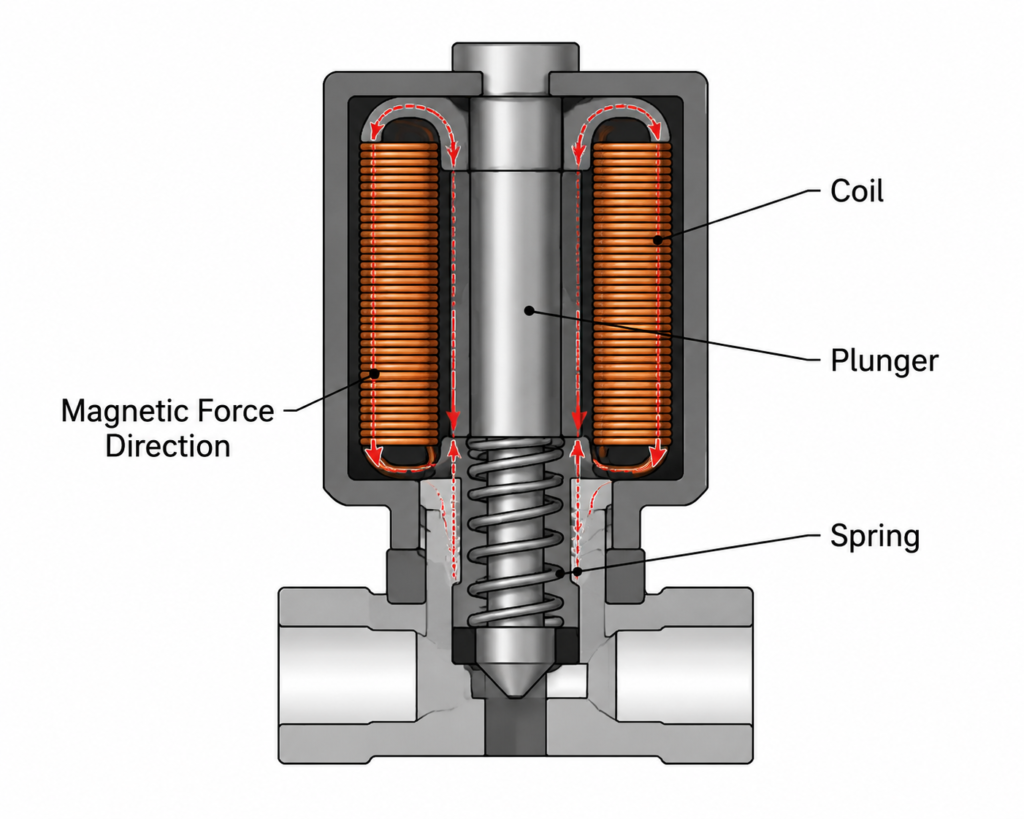
- Current is applied. Voltage is delivered to the coil terminals, and electric current flows through the wound wire.
- A magnetic field is generated. Following the principles of electromagnetism (Ampère’s law), the current-carrying coil produces a magnetic field along its central axis. The coil effectively becomes an electromagnet.
- The plunger is magnetized and pulled in. The magnetic field magnetizes the ferromagnetic plunger and pulls it toward the center of the coil — the point of maximum magnetic flux and minimum magnetic reluctance. This linear displacement is the motion that does the actual work.
- Mechanical action is produced. As the plunger moves, it pushes, pulls, or trips whatever mechanism it’s connected to — opening a valve, engaging a lock, or triggering a starter.
- Power is removed, and the spring resets. When current stops, the magnetic field collapses. The return spring pushes the plunger back to its resting position, ready for the next cycle.
In high-speed applications like fuel injectors, this on/off cycle can repeat thousands of times per minute — a testament to the speed and repeatability of the solenoid working principle.
Power Supply: How Do Solenoids Get Power?
A common question is how do solenoids get power, and the answer directly affects specification. Solenoids are powered in two ways:
- DC (direct current) — the most common for control applications. A 12V DC solenoid coil is the standard choice in automotive and industrial control panels; 24V DC is also widespread. DC solenoids run quieter, cooler on average, and are easier to control precisely.
- AC (alternating current) — often used where high force and fast response are needed (for example, some industrial valves). AC solenoids can be smaller for a given force, but they run louder and can overheat if the plunger fails to pull in fully.
Voltage choice directly affects performance: undervoltage means weak pull-in force and sluggish or failed operation; overvoltage overheats the coil and shortens its life. Always match the coil voltage to the supply — a 12V coil on a 24V supply will burn out quickly.
Types of Solenoids
Solenoids come in several configurations, each suited to different jobs:
- Linear solenoids produce straight-line push or pull motion — the most common type.
- Rotary solenoids convert electromagnetic force into rotational motion, used in sorters, indexed drives, and valve controls.
- Pull-type vs. push-type — pull solenoids draw the plunger inward (e.g., door locks); push solenoids drive it outward (e.g., eject mechanisms).
- Latching / bi-stable solenoids use a permanent magnet to hold the plunger in position without continuous power— ideal for energy-efficient or fail-safe applications. A brief pulse of current moves it one way; a reversed pulse moves it back.
For solenoid valves specifically, the number of “ways” (ports) defines the flow configuration:
- 2-way — simple on/off, two ports (inlet and outlet).
- 3-way — three ports, used for diverting or mixing flow.
- 4-way — four ports, typically used to control double-acting cylinders.
The “way” count is one of the most important selection dimensions for solenoid valves, and it’s worth a deeper look if you’re specifying one for pneumatics or hydraulics.
Solenoid Valve: The Most Common Application
While solenoids are used in many devices, the solenoid valve is by far the most common application — and likely the reason you’re reading this. A solenoid valve combines a solenoid actuator with a valve body: the solenoid handles the rapid on/off mechanical action, while the valve body controls the flow of liquid or gas through the ports.
So how do solenoid valves work? When the coil energizes, the plunger lifts (or presses) a sealing element — a diaphragm, piston, or poppet — opening or closing the flow path. When it de-energizes, the spring reseats the seal and flow stops. It’s the same fundamental solenoid working principle, just applied to fluid control.
Common Applications of Solenoids
What is the function of a solenoid in the real world? Here’s how the working principle translates across industries:
- Automotive — starter solenoids engage the starter motor; fuel injector solenoids meter fuel; transmission solenoids shift gears. Automotive runs on 12V DC, which is why how do 12V DC solenoid coils work is such a common question.
- Door locks and access control — electric strike and electromagnetic door locks use pull-type solenoids .
- Industrial automation — pneumatic and hydraulic valve banks, relays, contactors, and actuators.
- Irrigation and water control — sprinkler and drip systems use latching or low-power solenoid valves .
- Medical and appliances — from dosing pumps to coffee machines to dental chairs.
The common thread: whenever fast, repeatable, electrically-controlled motion is needed, a solenoid is usually the simplest, most reliable answer.
How to Choose the Right Solenoid
Choosing the right solenoid comes down to matching a few key parameters to your application. Get these right and you’ll avoid most common pitfalls:
- Voltage (AC vs. DC, and the value) — match the coil voltage to your supply. 12V DC and 24V DC are standard; confirm whether your system is AC or DC before ordering.
- Stroke length — the distance the plunger must travel. Too short and it won’t engage your mechanism; too long and force drops off.
- Force — the pull-in force needed at the required stroke. Always leave a 20–30% safety margin.
- Duty cycle — the ratio of on-time to total cycle time. Continuous-duty solenoids handle near-constant operation; intermittent-duty solenoids are smaller and cheaper but will overheat if held energized too long. Mismatching duty cycle is a leading cause of premature failure.
- Environmental rating — IP rating, temperature range, and corrosion resistance matter for outdoor or wash-down environments (think irrigation or food processing).
For solenoid valves specifically, also consider: port count (2/3/4-way), orifice size, the fluid being controlled, and whether you need normally-open (NO) or normally-closed (NC) operation.
Common Solenoid Failures and How to Check If a Solenoid Is Working
Most general guides stop here — but this is exactly what technicians and buyers need. Solenoids are simple, but when one fails, you need to know how do you check if a solenoid is working quickly.
Common failure modes
- Burnt coil — overheating (from overvoltage, wrong duty cycle, or a jammed plunger that draws high inrush current) melts the coil winding. Often visible as a burnt smell or discolored coil.
- Stuck or seized plunger — dirt, corrosion, or debris in the frame prevents the plunger from moving freely. The coil may still hum, but no motion occurs.
- Weak or broken return spring — the plunger pulls in but doesn’t reset, so the valve stays stuck open or closed.
- Mechanical overload — the connected load exceeds the solenoid’s force rating, so it pulls in slowly or not at all.
How to check if a solenoid is working
- Listen and feel. A healthy solenoid gives a distinct, crisp “click” when energized. No click — or a hum without motion — signals trouble.
- Check coil resistance (ohms). Disconnect power and measure across the terminals with a multimeter. Compare to the spec sheet — an open circuit (infinite resistance) means a burnt coil; a significantly low reading can mean a shorted winding. Anything well off-spec means replace it.
- Confirm voltage at the coil. When energized, verify the coil receives the correct voltage. Low voltage means weak pull-in.
- Test the plunger manually. With power off, the plunger should move freely and the spring should return it. Any binding, grinding, or resistance points to a mechanical issue.
- Check current draw. A solenoid draws higher inrush current on pull-in, then drops to holding current once seated. If current stays high and the plunger doesn’t seat, it’s likely jammed or overloaded.
If the coil checks out but motion is still weak, the problem is almost always mechanical (binding, overload, or low voltage) rather than electrical.
Frequently Asked Questions
What is the working principle of a solenoid?
A solenoid works by passing electric current through a coil to generate a magnetic field that pulls a movable ferromagnetic plunger into the coil, converting electrical energy into linear mechanical motion. When the current stops, a return spring resets the plunger.
What is the function of a solenoid?
The function of a solenoid is to convert an electrical signal into a fast, repeatable mechanical action — a push, pull, or switch — used to actuate valves, locks, starters, injectors, and countless other mechanisms.
How do solenoids get power?
Solenoids are powered by applying voltage across the coil terminals. Most run on DC (commonly 12V or 24V DC); some industrial types use AC. The coil voltage must match the supply to avoid weak operation (undervoltage) or burnout (overvoltage).
How do I know if my solenoid valve is working?
Listen for a crisp click when energized, measure coil resistance with a multimeter and compare to spec, confirm correct voltage at the coil, and verify the plunger moves freely by hand. No click, infinite resistance, or a jammed plunger all point to a fault.
What’s the difference between a solenoid and a solenoid valve?
A solenoid is the electromagnetic actuator (coil plus plunger) that creates motion. A solenoid valve is a complete product that uses a solenoid to open and close a fluid path. Put simply: the solenoid is the motor; the solenoid valve is the motor plus the plumbing.
Conclusion
Understanding how solenoids work comes down to one chain: current → magnetic field → plunger motion → mechanical work. From that single principle springs an enormous range of applications — and the better you grasp the working principle, the better you’ll specify, apply, and troubleshoot them.
If you’re specifying a solenoid or solenoid valve and want help matching the right type, voltage, and duty cycle to your application, [explore our product range] or [contact our team] — we’ll help you get the motion control right the first time.